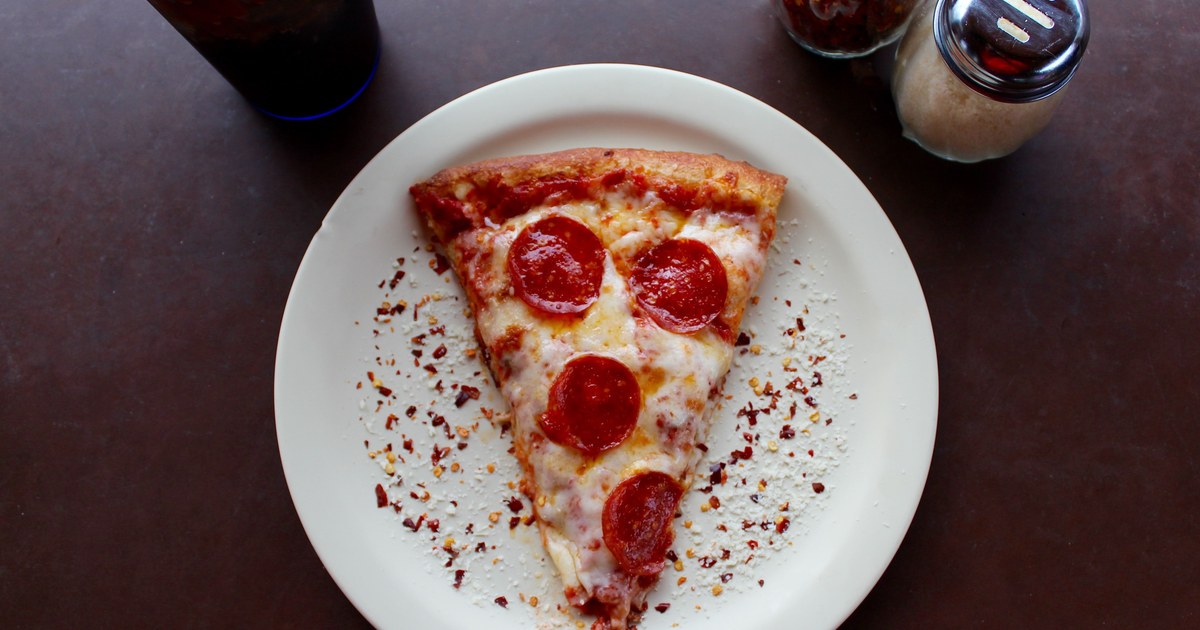
Most answers to “is pizza halal” try to settle the whole pizza with one word. That is why they are unsatisfying. A pizza is not a single ingredient, and the two parts shoppers actually worry about, the cheese and the meat on top, raise completely different questions with completely different ways of checking them. Answering them together means one of the two always gets answered badly.
Whether a pizza is halal depends on two separate checks: the rennet and enzymes in the cheese, and the slaughter status of any meat topping. The American Halal Foundation’s published standards exclude pork and all pork derivatives from certification outright, so pork-based pepperoni settles the topping question on its own. Unnamed rennet leaves the cheese question open.
Why “is pizza halal” is really two questions
Split the pizza and the confusion goes away. A plain margherita has no meat on it at all, so the only question is the cheese. A halal-certified beef pepperoni pizza has the topping question closed and the cheese question still live, if the cheese carries no certification of its own. A pork pepperoni pizza has the topping question closed in the other direction, and at that point the cheese no longer changes the outcome.
Those are genuinely independent variables. Knowing the answer to one tells you nothing about the other, which is exactly why a single yes or no for “pizza” cannot be right. Work through them one at a time and every pizza you meet resolves cleanly.
The cheese question is a rennet question
Cheese is settled by the coagulant, and that sub-question has its own long history. Rennet can come from a calf’s stomach, or it can be microbial or produced by fermentation with no animal involved. Where the rennet is animal-derived and the slaughter is unknown, the Sunni schools of law reach genuinely different published conclusions, and named certifiers apply different scheme criteria on top of that.
There is no point compressing all of that here. Our guide to cheese and rennet sets out who holds which position and why two careful shoppers reach opposite answers, and it is the authority on this sub-question. The short version: a microbial or fermentation-produced coagulant is the straightforward case, an unqualified “rennet” or “enzymes” on the panel is the one that leaves you without enough information to decide.
Two related labels turn up on pizza and inherit the same question. Whey is a by-product of cheesemaking, so a whey ingredient in a pizza base or a cheese blend points straight back at the rennet used upstream. And the bare word enzymes on a mozzarella pack hides its own source by design, since manufacturers are generally not required to name which enzyme or where it came from.
The American Halal Foundation’s guidance on cheese and dairy certification shows how much sits behind the word “cheese” once an auditor looks at it. Its published requirements cover the rennet, the enzymes used for coagulation and ripening, the starter cultures and the media those cultures are grown on, shared equipment and cross-contamination controls, and supplier documentation for every input. It states that if animal rennet is used it must come from halal-slaughtered animals, and that microbial or fermentation-produced rennet is generally permissible but must be verified so that the growth media contains no haram components. Almost none of that is printed on a pack, which is the honest reason certification carries weight that a label cannot. IFANCA, the Islamic Food and Nutrition Council of America, names the sharpest version of this on a pizza’s cheese: the enzyme derived from pigs is called pepsin, and IFANCA treats it as haram outright, the same absolute standing pork holds on the topping side.
The topping question is a slaughter question
The meat on top is a different kind of problem, and in one way a simpler one. Wikipedia’s entry on pepperoni records that pepperoni is made from pork, or from a mixture of pork and beef, and that turkey meat is also commonly used as a substitute, with the use of poultry in pepperoni required to be labelled appropriately in the United States. So “pepperoni” is a recipe name, not a species. The default is pork or pork and beef, and the alternatives exist and are labelled.
That gives you a clear path. Beef, chicken and turkey pepperoni are real products, and their sale alongside pork versions is exactly why the species has to be read off the label rather than assumed from the word “pepperoni.” Where a topping is beef, chicken or lamb rather than pork, the question shifts from species to slaughter: was the animal slaughtered according to Islamic requirements, which is something a certification mark can attest and an ingredient list cannot.
Sauces on speciality pizzas are worth a glance for a different reason. A marinated chicken or teriyaki-style topping often carries a marinade rather than plain seasoning, and soy sauce raises its own question about alcohol formed during brewing, on which certifiers do not all land in the same place. That is a third check, not a variation on the first two.
A frozen box and a takeout counter need different methods
The verification path depends on where the pizza comes from, and this is the practical difference most guides skip.
A packaged frozen pizza has a printed ingredient list and a legally regulated label. You can read the meat by name, look for a certification mark, and see whether the cheese names its coagulant. Everything you are entitled to know is on the box, and the work is reading it carefully.
A takeout counter has none of that. There is no panel to read, the cheese is bought in catering blocks whose spec sheet you never see, and the same oven, cutter and gloves may handle a pork pizza minutes earlier. The only useful move is asking the shop directly and getting an explicit sourcing statement: which certifier covers the meat, whether the cheese is certified, and how pork and non-pork orders are kept apart. A shop that has done this work usually answers immediately and often displays the certificate. A shop that has not will answer vaguely, and a vague answer is information too.
Neither path is stronger in the abstract. The box gives you a document with no ability to ask follow-up questions. The counter gives you a person you can question but no document. Knowing which one you are dealing with tells you which tool to use.
Zabihah reads the printed ingredients panel and gives AI-assisted general guidance on what each ingredient is and where it can come from, so an unqualified enzyme or an unnamed meat comes back flagged with the reason rather than as a false yes or no. It reads labels; it cannot inspect a kitchen, verify how an animal was slaughtered, or see what shared a cutter, and it is not a fatwa or a substitute for certification. For pizza, the deciding voice is an official certification mark and the scholar or certifying body you follow, applied to each of the two questions separately.