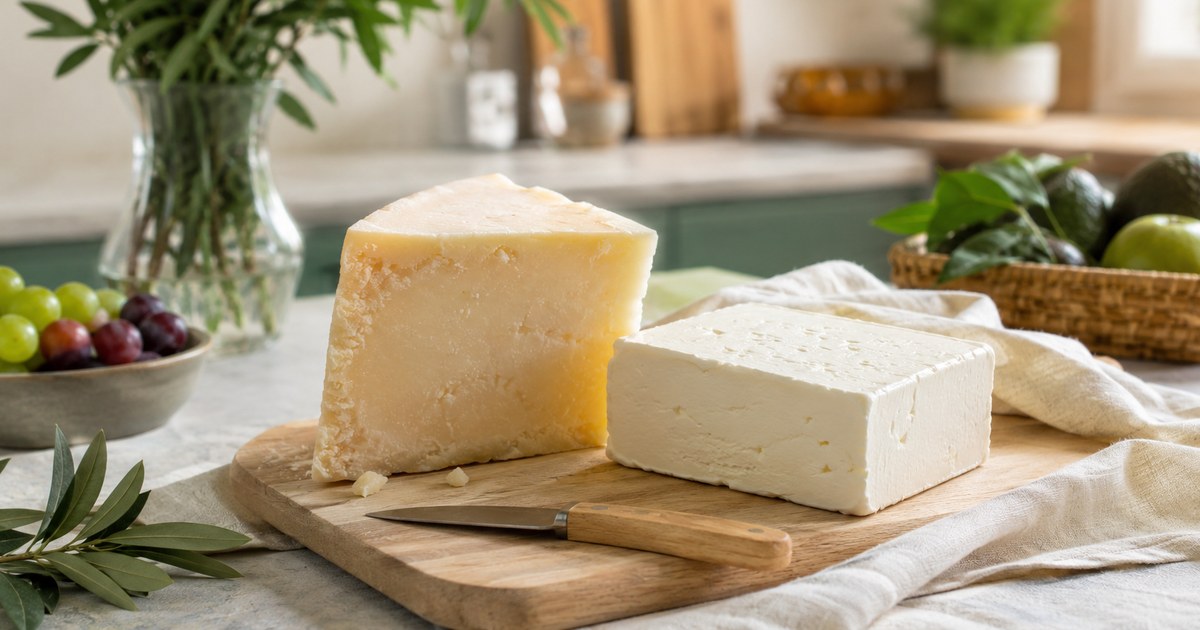
Ask two practising Muslims whether a block of cheddar is fine and you can get two confident, opposite answers from two people who have both done their homework. That is not carelessness on either side. The question “is cheese halal” runs straight into a documented disagreement between the Sunni schools of law that is centuries old and has never been resolved into a single position.
The disagreement is about rennet, the enzyme preparation used to curdle milk into curds. If the rennet is microbial or produced by fermentation, the named certifiers below treat it as unproblematic. If it came from a calf that was not slaughtered according to Islamic rules, the Hanafi school and the Maliki, Shafi’i and Hanbali schools reach different conclusions, each with published reasoning. Pig-derived enzymes are the point where the certifiers quoted below line up rather than diverge.
What rennet is and why it decides the question
Rennet is a set of enzymes, principally chymosin, that clot milk. IFANCA, the Islamic Food and Nutrition Council of America, describes the traditional source plainly: rennet comes from the stomach of young calves, extracted after the calf is slaughtered, not from a living animal. That single fact is what pulls a dairy product into the same territory as meat. Everything else in a plain cheese, milk and salt and cultures, is uncontroversial.
Because the coagulant is used in tiny quantities and is not what the cheese is made of, the scholarly discussion is not really about cheese at all. It is about whether an enzyme extracted from an animal that was not slaughtered in the prescribed way carries the impurity of that animal. That is the hinge, and it is where the schools part company. Our rennet ingredient page covers the substance itself in more detail.
The positions, and who holds them
The Hanafi position is set out in a published answer on SeekersGuidance, answered by Mawlana Ilyas Patel and checked by Shaykh Faraz Rabbani. It states that rennet obtained from an animal slaughtered by a non-Muslim or a Muslim, in accordance with Islamic law or contrary to it, is in all cases permissible, as long as the animal in question is not a pig. The reasoning given is that the lawfulness of rennet does not depend on who performed the slaughter but on whether the substance itself was alive: no blood flows through rennet, so on this analysis it does not die when the animal does. The same answer adds a note of caution that many readers miss, recommending that it is better to avoid rennet of unknown source where reasonably possible, precisely because of the difference of opinion between the Sunni schools.
The other side of that difference is documented on Islam Question & Answer, supervised by Shaykh Muhammad Salih al-Munajjid. Its answer on animal rennet reports that the majority of the Malikis, Shafi’is and Hanbalis hold rennet from an animal that died naturally or was not slaughtered according to Islamic law to be najis, impure, on the reasoning that the rennet becomes impure by virtue of the animal’s death. It reports Abu Hanifah, and Imam Ahmad according to one narration from him, as holding it to be tahir, pure. The same answer notes that Ibn Taymiyyah favoured the permissive view, on the ground that the enzymes in rennet do not die when the animal dies, and it closes by saying that an ordinary Muslim should follow a scholar who advises him toward one of the two opinions.
Read those two sources side by side and the shape of the thing is clear. This is not a case of one side having better information. It is a genuine juristic difference about the status of a non-living extract from a dead animal, both sides are published and reasoned, and the choice between them is a question for the reader’s own school and scholar, not for a website or an app. Vanilla extract sits in a comparable position for different reasons involving alcohol: the same ingredient, more than one defensible reading, named authorities on each side.
The one point of agreement
Pig-derived enzymes are not part of the disagreement. IFANCA’s published answer on cheese states directly that the enzyme derived from pigs is called pepsin and is haram, and notes that pig-derived lipase is still used in some strongly flavoured ripened cheeses. This is the one point in the whole discussion where the schools and the certifiers are not divided: IFANCA and the American Halal Foundation both treat pig-derived material as prohibited outright, without a threshold below which it stops mattering.
This is why the question on a cheese label is never only “is there rennet in it”. It is “what kind of enzyme, from what”. The coagulant and the ripening enzymes are separate questions, and neither is usually named on the pack.
Microbial rennet and fermentation-produced chymosin
There is a straightforward route around the whole dispute, and a large share of modern cheesemaking already takes it. Wikipedia’s account of rennet reports that fermentation-produced chymosin held about 90 percent of the global rennet market as of 2017. Microbial coagulants are produced by yeasts and fungi rather than extracted from an animal. Fermentation-produced chymosin goes one step further: the calf chymosin gene is inserted into a micro-organism, which then produces the enzyme by fermentation, with no animal involved in the production at all.
Named certifiers treat these as acceptable. IFANCA states that microbial enzymes are not derived from meat and are halal, and that chymosin produced using biotechnology is halal. The American Halal Foundation, in its guidance on cheese and dairy certification, lists plant-derived coagulants from sources such as thistle and nettle, and microbial enzymes derived from yeast and fungi, as the options suitable for halal cheese, and says animal rennet is not suitable for its certification because there is no guarantee of how the animal was slaughtered. That is a certifier applying its own scheme criteria, which is a different kind of statement from a school of law’s ruling, and both are worth knowing.
What “vegetarian rennet” on a label actually indicates
In the UK and Europe you will often see “vegetarian rennet”, “microbial rennet” or “suitable for vegetarians” on cheese. In practice that indicates a non-animal coagulant, which usually means a microbial enzyme or fermentation-produced chymosin. It is a useful signal, and it is often the only clue a pack gives you.
It is worth knowing how much weight that claim carries. The UK government’s own food labelling guidance is explicit that there is no legal definition of vegan food in UK law, though businesses must still label accurately and not mislead, and that a vegan label does not guarantee the absence of animal-origin material because shared production lines can introduce it unintentionally. Vegetarian claims sit in the same lightly defined space. So “vegetarian rennet” is a manufacturer’s description of the coagulant, made under a general duty not to mislead, rather than a certified statement about the whole product.
It also answers a narrower question than most shoppers assume. It speaks to the coagulant and nothing else. Other dairy ingredients, added enzymes, and the cultures used in ripening are outside what the phrase covers, which is exactly why IFANCA’s advice is to ask the producer where the enzyme comes from, or to look for certification.
Other dairy carries the same coagulant question
Cheese is not the only dairy product built on a cultured or set base. Yogurt raises a related but narrower version of this question, since a set-style pot can use gelatine alongside its cultures, and the same “which coagulant, from what” logic applies there too.
What to do in the aisle
The practical order is short. A halal certification mark on the pack is the strongest signal available and settles the sourcing question, because a body has audited it. Failing that, “microbial rennet”, “vegetarian rennet” or “not made with animal rennet” narrows the coagulant to the class the certifiers above accept. An unqualified “rennet” or “enzymes” leaves you in the doubtful category: not a verdict that the cheese is forbidden, an honest statement that the packet cannot tell you which of the positions above you are even deciding between.
Zabihah reads the ingredients panel and gives AI-assisted general guidance on what each ingredient is and where it can come from, so an unlabelled enzyme comes back as doubtful with the reason rather than as a false yes or no. It reads labels; it cannot inspect a dairy or verify how an animal was slaughtered. For a question this well documented and this genuinely contested, the deciding voice is an official certification and the scholar or certifying body you follow.