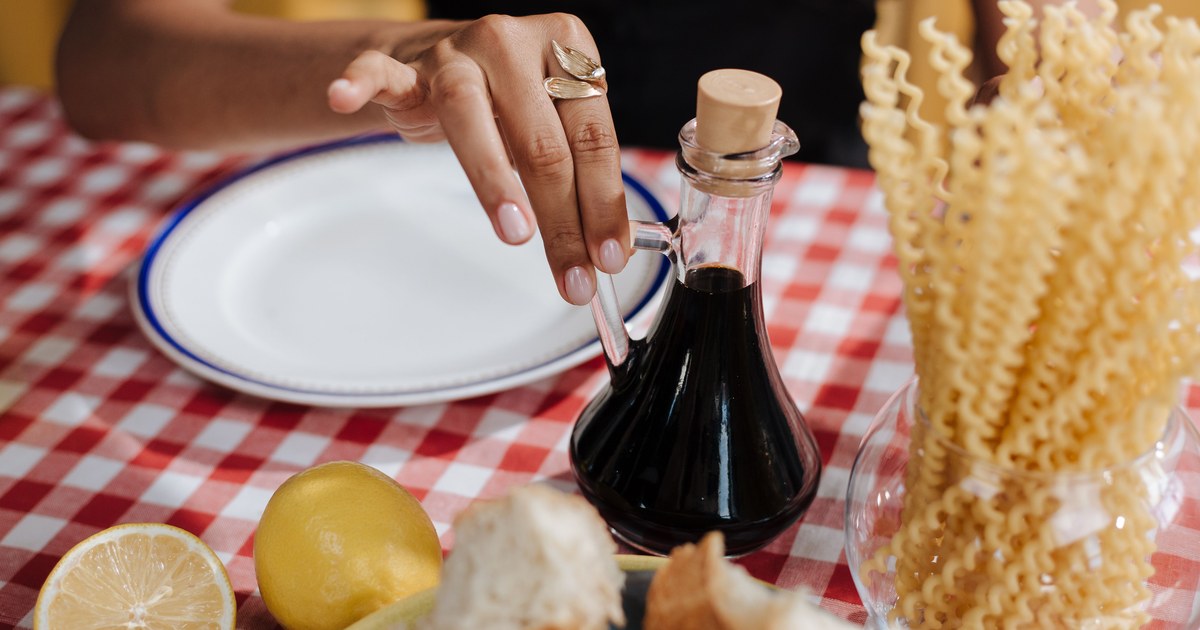
Vinegar is in almost every kitchen and on an enormous number of ingredient panels: pickles, ketchup, mayonnaise, salad dressings, crisps, marinades, sauces and bread. It also carries a reputation for being complicated, because somewhere along the line most shoppers have heard that vinegar has something to do with wine. Anyone who has typed “is vinegar halal” into a search bar while standing in the aisle deserves the genuinely useful part first: the complication applies to two kinds of vinegar and not to the rest of the shelf.
“Is vinegar halal” is really two questions wearing one label. Most vinegar sold for cooking, including white distilled, apple cider, rice and malt, is not made from wine and raises no wine-origin question at all. Only wine vinegar and balsamic vinegar reach the point where named scholars and schools of thought have published genuinely different positions.
What is actually in the bottle
Vinegar is made in two stages. Wikipedia’s entry on vinegar describes the process as converting simple sugars to ethanol using yeast, and then converting that ethanol to acetic acid using acetic acid bacteria. Every vinegar passes through an alcohol stage on its way to being vinegar, which is why the claim that “all vinegar comes from alcohol” keeps circulating. What actually differs between bottles is the raw material the process starts from.
The same entry describes the main types. White distilled vinegar is made from fermented distilled alcohol, often from barley malt or corn in the United States, and comes out as a colourless solution of roughly 5 to 8 per cent acetic acid. Apple cider vinegar is made from cider or apple must. Rice vinegar is made from fermented rice. Malt vinegar is made by malting barley, converting the starch to maltose, then brewing and fermenting an ale. Wine vinegar is made from red or white wine, and is the most common style across southern and central Europe. Balsamic vinegar is made from the concentrated juice of white Trebbiano grapes.
Four of those six never involve wine. That is the fact that does most of the work at the shelf, and it is why a bottle labelled white vinegar, spirit vinegar, apple cider vinegar or rice vinegar is not the subject of the disagreement below.
Why “is vinegar halal” narrows to two bottles
Wine vinegar is the obvious one, because the label names its own starting material. Balsamic is the less obvious one, and it deserves a sentence of its own. Traditional balsamic is made from cooked grape must rather than from finished wine. The commercial product is different: Wikipedia’s entry on balsamic vinegar states that ordinary Balsamic Vinegar of Modena is made from as little as 20 per cent grape must, with the addition of wine vinegar at a minimum of 10 per cent and caramel at a maximum of 2 per cent. So the everyday supermarket balsamic contains wine vinegar as a declared component. That is why it belongs in the same paragraph as wine vinegar rather than with the cider and rice bottles.
Everything else in this article is about those two labels.
What the International Islamic Fiqh Academy resolved
The International Islamic Fiqh Academy, the fiqh body of the Organisation of Islamic Cooperation, addressed this directly. In Resolution No. 225 (9/23), issued at its twenty-third session in 2018 in response to halal questions put to it by the Standards and Metrology Institute for Islamic Countries, question 14 asks: “What is the ruling on using the vinegar made from alcohol?” The Academy’s published answer is: “There is no objection in using the vinegar made from alcohol.”
That answer rests on the principle known in fiqh as istihalah, the complete transformation of a substance into a different substance with different properties. Applied here, the reasoning is that the intoxicant no longer exists once the acetic acid bacteria have finished with it, so what is in the bottle is not the thing that was prohibited. It is worth noticing what the Academy’s answer does not do: it gives one ruling and does not separate a vinegar that turned on its own from one that was deliberately turned.
Where the schools genuinely differ
That separation is exactly where the disagreement lives, and flattening it would be dishonest.
Darul Ifta Birmingham, answering through IslamQA, sets out the two positions side by side. Shaykh Mohammed Tosir Miah writes that “Imam Abu Hanifa is of the view that if wine changed into vinegar, either by itself or deliberately, it will be permissible to consume.” The Shafi’i position in the same answer is narrower: if the wine turned to vinegar by itself, without any deliberate change, it is permissible, but it is not permissible to deliberately change the wine into vinegar.
Islam Question & Answer, answering a reader on balsamic vinegar, describes the same split from the other side. Vinegar that transforms naturally is treated as permissible, and the answer cites the prophetic praise of vinegar as a condiment. Where wine is deliberately processed into vinegar, it records that scholars disagree, with the stricter view relying on a report in which the Prophet told someone not to deliberately convert wine into vinegar. That same answer then reaches a further conclusion of its own: that vinegar produced by Christians in Europe and elsewhere by treating wine is permissible to consume, because the prohibition it cites is on a Muslim deliberately converting wine, not on the transformed product itself once it has passed through other hands.
This is not an academic distinction. Commercial vinegar is not a bottle left in a cupboard to spoil. It is made by deliberately introducing acetic acid bacteria to ethanol under controlled conditions, which is the process the vinegar entry describes. So an industrial wine vinegar sits squarely in the induced category rather than the natural one, and a reader following a school that draws that line is asking a live question, not a hypothetical one.
How this differs from the other alcohol questions on a label
Three separate shapes of question get bundled together under “alcohol on an ingredient list”, and keeping them apart makes each one easier.
The first is alcohol deliberately added and still present, which is the vanilla extract question, where certifiers reach different published conclusions about a flavouring carried in ethanol. The second is alcohol produced incidentally by fermentation and left in trace amounts, which is the soy sauce question. Vinegar is the third shape and the cleanest of the three: the alcohol is not added, not residual by accident, and not meant to survive. It is consumed by the process on purpose and turned into acid.
That is why the vinegar discussion is about the starting material rather than about a percentage on a spec sheet. A bare “vinegar” in an ingredient list of a packaged sauce, however, does not say which starting material it came from, and an ingredient whose origin is simply unstated is the textbook case of what the word mushbooh exists to describe.
The quick read at the shelf
Read the word immediately before “vinegar”. If it says white, distilled, spirit, apple cider, rice or malt, the bottle has named a starting material that is not wine, and the positions above are not about it. If it says wine vinegar, red wine vinegar, white wine vinegar, balsamic vinegar or Balsamic Vinegar of Modena, you are looking at the bottle those positions are about, and the answer depends on which school and which published position you follow.
If a packaged food’s ingredient list just says “vinegar” with nothing before it, it has not told you. Treat that as open rather than decided, and let a certification mark or the manufacturer close it, which is the same order that applies to reading any packaged food. A halal certification mark from a body you follow settles the starting material and the process together, because the certifier has audited the supplier rather than inferred from a word on the front.
Zabihah reads the printed ingredient list and gives AI-assisted general guidance from it, so a named apple cider or rice vinegar comes back as the straightforward line it is, while a bare “vinegar” or a wine-derived one is flagged as a question with the reason attached. It is not a fatwa and not a substitute for certification, and it reads labels rather than inspecting a production facility. Where the schools of thought differ, as they do here, an official certification and your own scholar or certifying body remain the deciding voices. Honey is the mirror case, where the base ingredient is settled and the doubt sits in what gets added, covered in is honey halal.