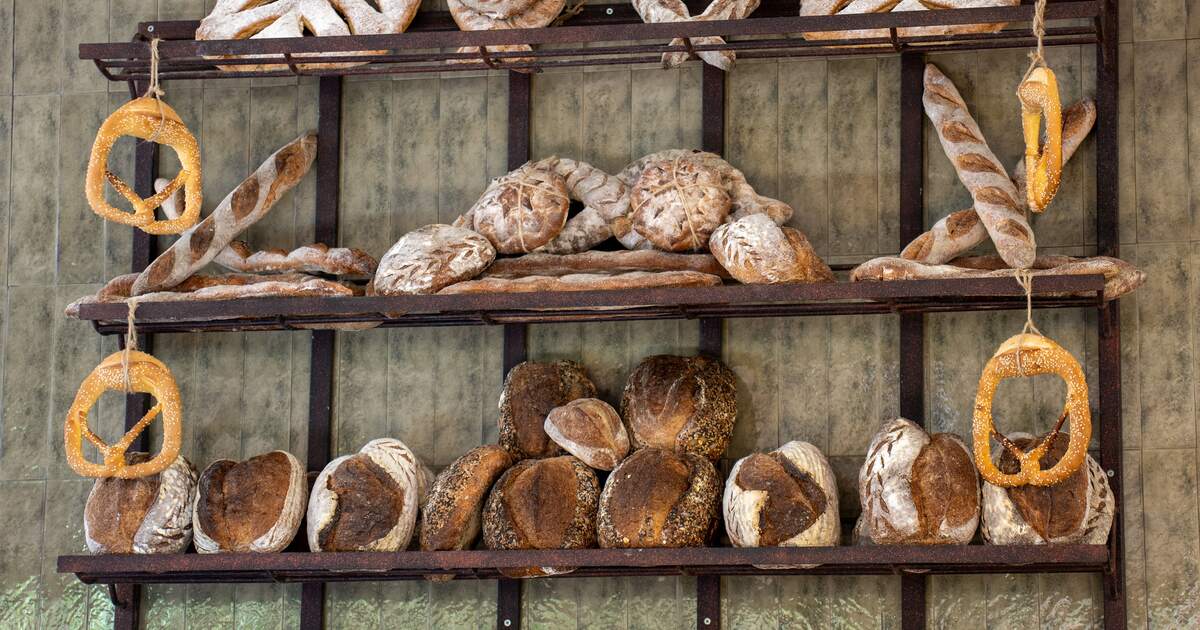
Bread is about the last thing most people expect to check a label on, and for a plain loaf that instinct is right. Wikipedia’s entry on bread describes it in its simplest form as a food made from a dough of flour and water, usually with a leavening agent such as yeast, and salt. Those four things raise no question at all. The reason “is bread halal” is a real search is that factory bread rarely stops at four ingredients.
The honest answer is that a basic loaf of flour, water, yeast and salt has nothing to investigate, but industrial breads add dough conditioners, emulsifiers, enzymes and sometimes milk ingredients, and one or two of those are genuinely source-dependent. The certifiers and scholars below read those specific additives rather than issuing a verdict on bread as a category.
The additive most people have never heard of
The one worth knowing about is L-cysteine, listed as E920. It is a dough conditioner, or, as Wikipedia’s entry on cysteine puts it, a processing aid for baking that improves the dough, widely used in commercial bread, burger buns and some pastries. It is the additive on this list most likely to raise a real sourcing question.
That is because of where it comes from. Wikipedia’s entry states that the majority of L-cysteine is obtained industrially by hydrolysis of animal materials, such as poultry feathers or hog hair, and separately notes that human hair is rarely a source material and is prohibited in EU food and cosmetic manufacturing. It also describes a synthetic route produced by fermentation using an engineered bacterial strain. So E920 can trace back to poultry feathers, to pig hair, or to a fermentation process with no animal involved, and a bread label almost never records which. The same fermentation-linked sourcing question comes up with soy sauce, where a naturally brewed batch can carry trace alcohol left over from the process. The possible pig origin is why this one draws more attention than a typical emulsifier.
Named authorities read it in different ways, and reporting the difference is more useful than picking one. On one side, Islam Question & Answer, supervised by Shaykh Muhammad Salih al-Munajjid, addresses E920 directly and concludes that there is nothing wrong with eating foods containing L-cysteine whatever its source, on the reasoning that it does not remain in its original condition but is transformed into another substance, the principle of istihalah. That transformation principle is itself contested where the origin is an impermissible animal. As covered on the jello and gelatine question, the Islamic Fiqh Council in Jeddah declined to accept istihalah for pig-derived gelatine while permissible alternatives exist, a stricter reading of the same principle. In line with that more cautious view, several certification schemes prefer L-cysteine whose source is verified as synthetic, fermentation-derived or from a permissible animal, precisely because of the poultry-feather and pig-hair possibilities. A certifier’s mark resolves it by having checked the source. The dedicated L-cysteine ingredient page covers the substance in more detail.
The other watchpoints in a factory loaf
Beyond E920, three lighter ones appear in packaged bread. The first is the emulsifier: mono- and diglycerides (E471) keep the crumb soft, and, as Wikipedia notes, they are made from glycerol and fats that can be plant or animal in origin, which is why IFANCA, the Islamic Food and Nutrition Council of America, lists them in its “Investigate Further” column. Our guide to mono- and diglycerides covers that one.
The second is enzymes, such as amylases, added to improve rise and shelf life. These are usually microbial today, but the word “enzymes” hides its own source in the same way, and IFANCA lists enzymes in the same investigate-further bucket. Our guide to enzymes on an ingredient list sets out how to read them.
The third is dairy. Some breads, especially soft rolls and enriched loaves, add milk powder or whey. Whey carries its own question because it traces back to the coagulant used to make the cheese it came from. Everything else in a standard loaf, the flour, the yeast, the salt and the sugar, is uncontroversial.
Why two loaves can differ
Because L-cysteine, the emulsifier and the enzymes are all source-dependent, two similar sliced loaves can reach different conclusions. A simple loaf with no conditioners and a vegetable emulsifier has little to question. A soft commercial bread with an unspecified E920 and an unqualified E471 is the doubtful case, and doubtful means the label has not told you enough, not that the bread is forbidden. This is the ordinary mushbooh pattern: a settled rule and a missing fact.
The quick read at the bakery aisle
A short ingredient list of flour, water, yeast and salt needs no further thought. On a longer list, look for E920 or “L-cysteine”, check the emulsifier for a “vegetable” qualifier, and note any whey or milk powder. A halal certification mark from a body you follow settles all of it at once, because it means the conditioner and emulsifier sources have been checked. The same reading order for any packaged food applies here.
Zabihah reads the printed ingredient list and gives AI-assisted general guidance from it, flagging an unspecified E920 or emulsifier as doubtful with the reason, rather than guessing a source it cannot see. It is not a fatwa and not a substitute for certification, and it reads labels rather than tracing a bakery’s supply chain. For anything that matters to you, an official certification and your own scholar or certifying body remain the deciding voice.