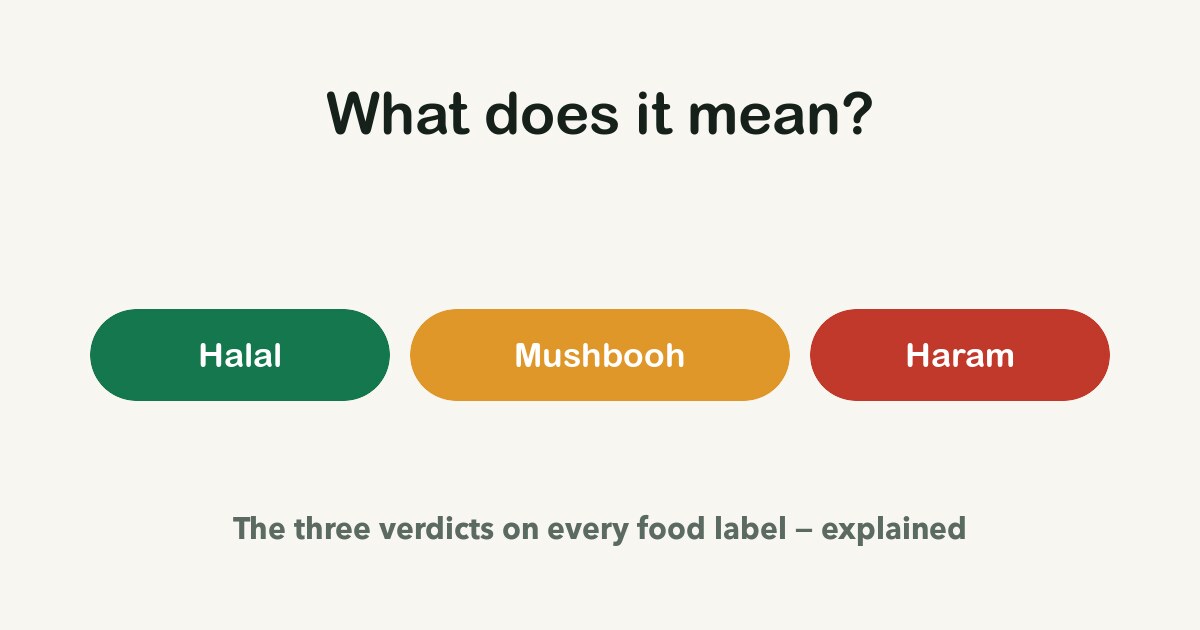
Three words carry most of the weight in any halal food conversation, and only two of them are widely known. Halal and haram are the pair everyone learns first. The word that decides what actually happens in a supermarket aisle is the third one, mushbooh, and a fourth, makrooh, appears often enough to be worth knowing as well.
This is the definitional piece the rest of this site refers back to. It is about what the words mean, who defines them, and why the boundaries between them are not identical everywhere, rather than about any one product.
Halal and haram: the two clear words
IFANCA, the Islamic Food and Nutrition Council of America, gives the plain translation on its own explainer: halal is an Arabic word meaning lawful or permitted, and its opposite, haram, means unlawful or prohibited. The American Halal Foundation renders the same pair as “lawful or permitted” and “unlawful or not allowed” in its own definitions, and adds something worth holding on to. With respect to halal, AHF writes, there are no restrictions of consumption or use; with respect to haram, the restrictions are absolute.
So the two words are not the ends of a sliding scale of preference. They are the two outcomes of a classification, and the whole practical question is which one a given thing falls into.
Both bodies also frame the starting point the same way. AHF describes the governing principle as one of natural permissibility, where most foods and drinks are considered permitted unless specifically forbidden. That is why plain rice, lentils, apples and flour never generate an argument. The question only begins when an ingredient could be carrying something else along with it.
What puts a food in the haram category
IFANCA’s explainer lists the sources it treats as not halal: swine and its by-products; animals not properly slaughtered according to the Islamic method, or dead before slaughter; alcoholic drinks and intoxicants; carnivorous animals and birds of prey; blood and blood by-products; and foods contaminated with material from any of those categories. AHF compresses its own version into a mnemonic covering alcohol and other intoxicants, blood, carnivorous animals, dead meat that was not slaughtered according to Islamic rites, food offered to idols, and swine with all of its derivatives.
Look at the shape of those lists rather than the contents. At least two entries in each (the slaughter condition, and contamination) are not properties of an ingredient at all. They are properties of a process, and no packet reports on a process. That gap is where most real uncertainty in a shop comes from, and it is exactly why the third word exists.
Mushbooh: doubt about a fact, not about the rule
Mushbooh, also written mashbooh, means doubtful, questionable or suspected. AHF’s published definition is the more precise of the two: Islamic law uses the category to cover the grey area between the halal and the haram, where doubtful evidence, or doubt about how a text applies to a particular circumstance, leaves a person unsure. IFANCA states the consumer version in a line: some things are not clear, and further information is needed before they can be categorised.
That word “information” is the point. A shopper holding a jar is very rarely in doubt about the rule. The rule is settled, and both organisations state it identically. What is missing is a fact about the jar. IFANCA names the recurring culprits without hedging: foods containing ingredients such as gelatin, enzymes, emulsifiers and flavours are questionable, because the origin of those ingredients, or of their components, may be haram.
Mushbooh is therefore not a soft “probably fine”, and it is not a quiet “probably not”. It is an accurate description of a missing fact, and a good one points at the exact line on the packet that created the gap. AHF’s own guidance on gelatin shows how such a gap gets closed in practice: it treats the halal status of gelatin as depending on source, processing and contamination, and advises consumers to look for gelatin certified by an internationally recognised halal certification body rather than to reason it out from the word on the label. The marshmallow packet is the everyday version of exactly this gap: a single word, gelatine, that the label leaves unsourced.
AHF also sets out where the practice of avoiding the doubtful comes from, grounding it in a hadith reported in Sahih al-Bukhari and Sahih Muslim in which the lawful and the unlawful are described as clear, with doubtful matters lying in between that many people cannot classify. How that applies to a particular product in your hand is a question for your own scholar or certifying body, and not for a website.
Makrooh: the fourth word you will occasionally meet
Makrooh means discouraged or detested. AHF keeps it as a separate category rather than a weaker form of haram: something disapproved of, though not strongly, covering substances that are harmful to the body physically, mentally, psychologically or spiritually. Its examples are things like harmful stimulants, dependency-forming substances and smoking materials, which is why you are far more likely to meet the word in a discussion than on a food label. It is worth recognising so that you do not read it as a synonym for any of the other three.
The categories are shared, the boundaries are not
Here is the part that catches people out. Scholars and certifiers use the same vocabulary, but they do not always sort the same substance into the same box, and reputable bodies publish genuinely different positions.
You can see it in how two American organisations present the same material. AHF’s explainer lays out the classical categories one by one. IFANCA’s shopping guide compresses them into two practical buckets for a consumer with a trolley: “Haram / Avoid” for things it describes as unquestionably haram and present in large proportions, with lard and spirits as its examples, and “Investigate Further” for components used in small quantities whose subcomponents may come from haram animals, from alcohol, or from halal animals slaughtered by non-Muslims. That second bucket is long. It includes enzymes, whey, mono- and diglycerides, stearic acid, glycerin, natural and artificial flavourings, and a run of E-numbers. Neither presentation is wrong; they are built for different jobs.
Differences appear inside the haram category too, not only in the doubtful one. Two established UK certifiers hold opposite public positions on stunning before slaughter. The Halal Monitoring Committee states in its FAQs that animals are not stunned. The Halal Food Authority states in its FAQs that it prohibits captive bolt and percussion stunning but permits controlled electric stunning at minimal amperage, verified by a veterinary surgeon, for poultry and ovine meat. Both publish their criteria openly. A shopper who follows one standard and a shopper who follows the other will read the same meat counter differently, and both are reading it correctly. That is the practical reason a logo tells you which standard was applied rather than that a food is universally halal, which we unpack certifier by certifier in halal certification marks explained. Neither this site nor any app is in a position to tell you which of those standards to follow. The same is true where the schools of law themselves reach different conclusions, as they do over animal rennet in cheese: the honest thing is to name the positions, not to quietly pick one on your behalf.
These words are written into standards, not only into conversation
It is easy to treat all four as informal vocabulary. They are also technical terms in published standards, with auditable requirements attached.
GSO 2055-1:2015, “Halal Food, Part 1: General Requirements”, is a Gulf Technical Regulation approved in November 2015 by the GCC Standardization Organization. Its scope defines general requirements for halal food to be followed at every stage of the chain, covering receiving, preparation, packaging, labelling, handling, transportation, distribution, storage, displaying and food service. SMIIC, the Standards and Metrology Institute for Islamic Countries, publishes the OIC/SMIIC series to harmonise standards among member states of the Organisation of Islamic Cooperation. Malaysia’s national scheme is run by the Halal Management Division of JAKIM through the official Halal Malaysia portal.
That layer changes how you read a mark on a packet. A certifier stating that a product is halal is not making a general philosophical claim. It is recording that a named organisation audited a named producer against a written standard and found it compliant.
What the three words look like with a packet in your hand
In a shop the categories collapse into three actions. If the panel names something a certifier lists as prohibited, the decision is made and you can move on. If everything on the panel is plainly plant, mineral or clearly sourced, there is nothing to resolve. The interesting case is the middle one, where a single word such as gelatin, whey, mono- and diglycerides, rennet, carmine or L-cysteine can come from more than one origin and the label does not say which. The same additive can be plant, synthetic or animal-derived depending on the manufacturer, which is why the word alone settles nothing.
Cheese is the clearest worked example of why the middle category exists, because the schools of thought genuinely differ on rennet rather than simply lacking information: why two shoppers can reach two different answers on cheese sets out who holds what, and what a label can and cannot show you.
Treating that middle case honestly turns a vague worry about a whole product into one specific question you can actually answer: email the manufacturer, look for a certified alternative, or follow the position of the scholar or certifying body you rely on. The step-by-step version is in how to check if a packaged food is halal, and the individual ingredients are collected at is it halal.
Where a scan stops
Zabihah reads what is printed on the pack and returns each ingredient as halal, haram or mushbooh, with a plain-English reason for anything doubtful and a note on which authority treats it that way. Our methodology sets out how that assessment is built. It is AI-assisted general guidance from a declared ingredient list. It is not a fatwa, and it is not a substitute for official halal certification. It reads labels, so it cannot verify a slaughter method, detect cross-contamination on a shared line, or trace a supply chain, and it will not pretend otherwise. For anything that matters to you, an official certification, read alongside the standard your own scholar or certifying body follows, is the final word.
Sources
- IFANCA: What is halal?
- IFANCA: Halal Shopper's Guide to Ingredients
- American Halal Foundation: What is Halal?
- American Halal Foundation: Is Gelatin Halal?
- Halal Food Authority FAQs
- Halal Monitoring Committee FAQs
- GSO 2055-1:2015 Halal food, general requirements
- SMIIC, Standards and Metrology Institute for Islamic Countries
- Halal Malaysia Official Portal, JAKIM Halal Management Division