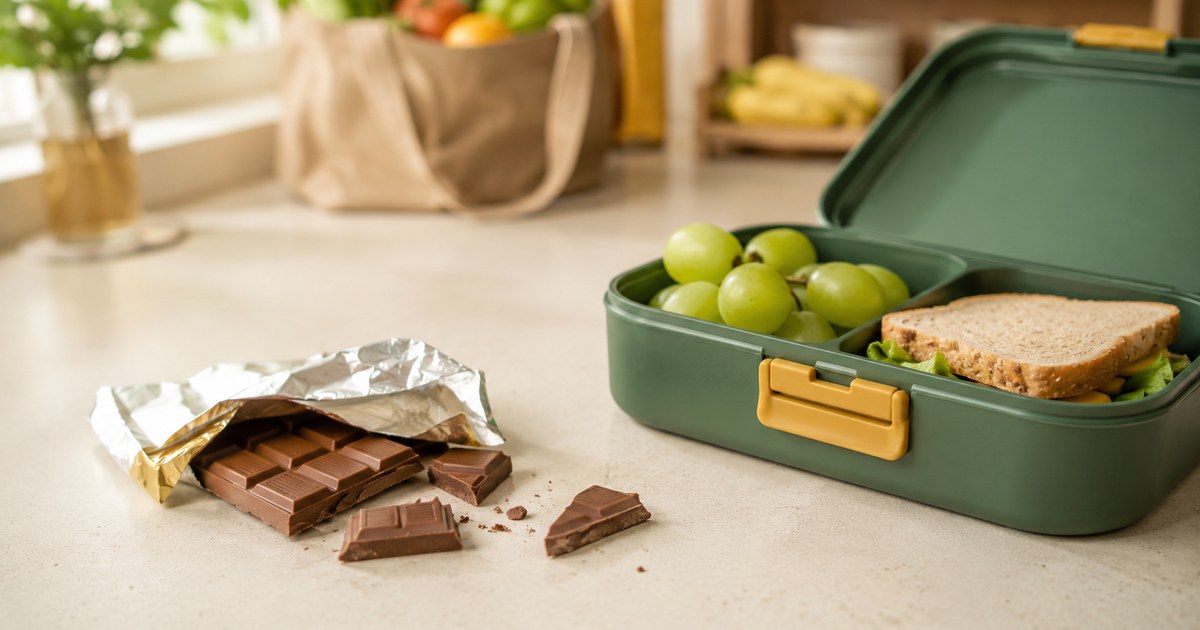
Packing a lunchbox is a small daily decision you would rather not have to research. A chocolate bar goes in or it does not, and you have about four seconds at the cupboard to decide. So the useful version of the question is chocolate halal is not a yes or a no about chocolate in general. It is a short list of the three places on the ingredient list where the answer actually gets decided.
At its simplest, chocolate is cocoa mass, cocoa butter and sugar, all plant ingredients. The questions come from what is added around them: whey, whose production may involve animal rennet; emulsifiers such as E322 lecithin, E471 mono- and diglycerides and E476 PGPR, whose sources vary by manufacturer; and alcohol-bearing flavourings used in soft fillings. Those three checks are what a label can tell you.
These three checks do not expire the way a list of approved bars does. They are properties of ingredient classes rather than of products, so once you know them you can read any wrapper, in any country, and find the line that decides the answer.
Check one: whey, and the rennet lineage behind it
Milk chocolate and most filled bars carry milk solids, and very often whey or whey powder, which is the liquid left over when milk is separated into curds and whey. According to Wikipedia’s summary of whey production, that separation is achieved either with rennet or with an edible acid: rennet coagulation gives sweet whey, acid coagulation gives acid whey. So a whey ingredient may or may not have passed through rennet, and the packet does not say which.
That matters because rennet itself has more than one origin, and the schools of law differ on animal rennet, which is the subject of our guide to cheese and rennet. The American Halal Foundation, setting out its own scheme criteria for cheese and dairy, accepts plant coagulants such as thistle and nettle and microbial enzymes derived from yeast and fungi, and does not accept animal rennet, on the ground that there is no guarantee of how the animal was slaughtered.
None of that is printed on a chocolate wrapper. That is why a whey line with no stated coagulant is usually treated as doubtful rather than settled: a certifier auditing a facility can read the coagulant off the supplier paperwork, and a shopper reading a wrapper cannot.
Check two: the emulsifiers, and why they are source-dependent
Chocolate is a suspension of solid particles in fat, so it almost always needs an emulsifier. Three appear over and over.
Lecithin (E322) keeps cocoa particles and cocoa butter from separating and controls how the chocolate flows. Wikipedia lists its commercial sources as soybean oil, sunflower, rapeseed and other plant oils, and also milk, egg yolk and marine sources. The American Halal Foundation describes soy and sunflower lecithin as plant-derived and generally accepted, while noting that lecithin extracted with ethanol-based solvents may still require verification. So the E-number alone does not tell you the origin, but “soya lecithin” or “sunflower lecithin” on the panel does; our dedicated page on soy lecithin covers why that named version is usually the easy one.
Mono- and diglycerides (E471) are the classic source-dependent emulsifier. Wikipedia notes that E471 is mainly produced from vegetable oils including soybean, sunflower, palm and coconut, that animal fats are sometimes used and cannot be completely excluded, and that the fatty acids are chemically identical whichever origin they came from. Chemical identity is the whole problem: no test on the finished bar recovers the origin, so the answer lives in the manufacturer’s records. The American Halal Foundation’s position is that E471 can be derived from plant oils or from animal fats and therefore requires verification. That is why E471 is so often flagged as mushbooh, meaning doubtful, rather than pushed into a yes or a no.
PGPR (E476) is the one people have not usually heard of. Wikipedia describes polyglycerol polyricinoleate as an emulsifier made from glycerol and fatty acids, usually from castor bean and sometimes soybean oil, used to reduce the viscosity of molten chocolate so less cocoa butter is needed. The feedstocks named there are plant oils. The American Halal Foundation still lists E476 among the emulsifiers whose source and process need verification rather than assumption. It is built from glycerol and fatty acids, the same building blocks whose origin is the open question in E471, so it belongs on the list of lines worth reading rather than the list of lines you can skip.
Check three: alcohol carried in flavourings and fillings
The third place to look is not an additive at all. It is the filling. Soft centres, caramels, creams and truffle-style fillings are flavoured, and some flavourings are alcohol-based extracts.
Vanilla is the clearest example, because the United States has written the alcohol content into law. The federal standard of identity at 21 CFR 169.175 requires that vanilla extract contain not less than 35 percent ethyl alcohol by volume. That ethanol is a solvent, most of it flashes off during baking or processing, and the residue in a finished sweet is very small. Named bodies publish different thresholds for that residue. IFANCA’s published position is that alcohol may be used to extract or dissolve flavours provided the amount is reduced to less than 0.5 percent in the final flavouring product. The Fatwa Committee of Majlis Ugama Islam Singapura sets a two-level limit: not more than 0.5 percent in the flavouring and not more than 0.1 percent in the finished food. Those are two published standards that do not measure the same thing, and our guide to vanilla extract and alcohol sets the positions out in full. The one that binds you is the one your own certifying body or scholar holds.
Separately from flavourings, some filled and liqueur-style confectionery contains added spirits as an ingredient in their own right. That is a different situation from a trace solvent, and it is normally declared on the panel in plain words, so it is the easiest of all these checks to make.
What to do at the shelf
Look for a certifier’s mark first, from a body you follow, and check that it is current and that it covers this product rather than the brand in general. Where it does, the three checks below have already been done by people who can see the supplier records.
With no mark, read the panel in this order. Milk and whey terms: is a coagulant or a “vegetarian” or “microbial” qualifier stated. Emulsifier line: does it say soya lecithin, sunflower lecithin, or a bare E471 or E476 with no origin. Filling and flavouring: any extract, liqueur or spirit named. If all three come back explicit, you have your answer. If any one comes back bare, the accurate category is doubtful, and the resolution is a message to the manufacturer or a certified alternative rather than a guess. The same three-line read works on marshmallows and most other sweets, which is why it is worth learning once.
Zabihah is built to do that read for you: point the camera at the ingredient panel and each item comes back as halal, haram or mushbooh with the reason it landed there. It gives AI-assisted general guidance from the declared ingredient list. It is not a fatwa and not a substitute for official halal certification, and for a product that matters to you, a certifier’s mark or your own scholar remains the final word.
Sources
- Are Emulsifiers Halal? (American Halal Foundation)
- American Halal Foundation: Halal Certification for Cheese and Dairy
- What's in Natural and Artificial Flavors? (IFANCA)
- Fatwa on Ethanol, Majlis Ugama Islam Singapura
- Whey (Wikipedia)
- Lecithin (Wikipedia)
- Mono- and diglycerides of fatty acids (Wikipedia)
- Polyglycerol polyricinoleate (Wikipedia)
- 21 CFR 169.175, Vanilla extract (GovInfo)