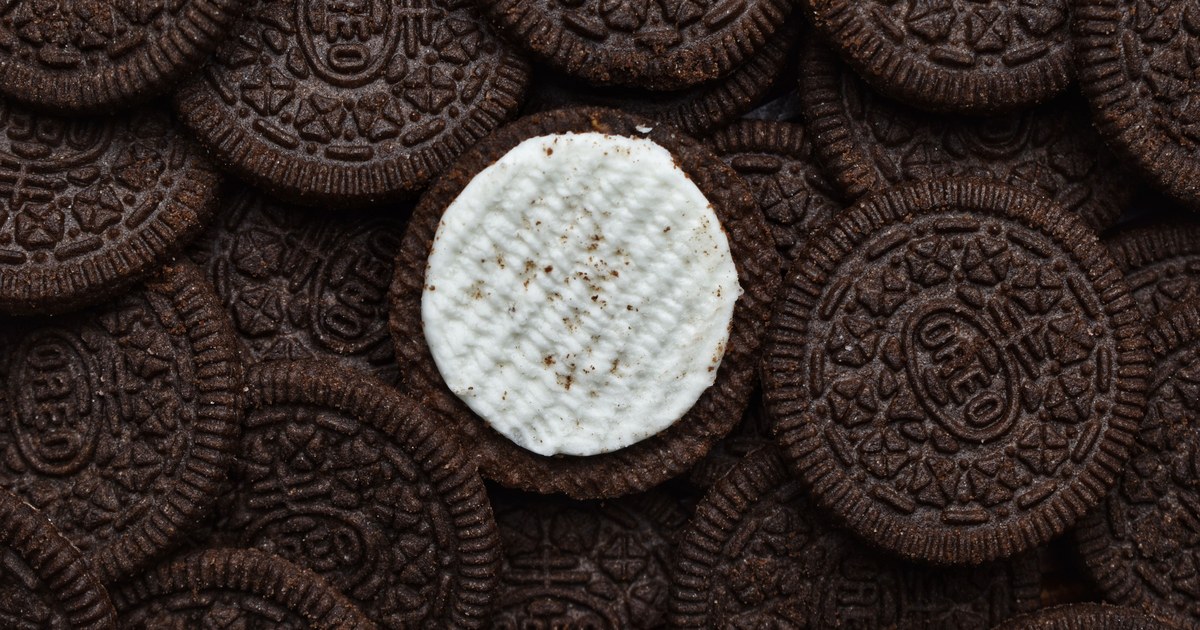
Oreos have an unusual place in this conversation. They are one of the few supermarket biscuits that a shopper is likely to have been told, confidently and by several different people, both that they are fine and that they are not. Vegan lists include them. Older posts warn about lard. Packs bought abroad sometimes carry a certifier’s mark and packs bought at home do not. So “are Oreos halal” is not really one question, and the answer someone gives you usually depends on which country’s packet they were looking at.
The honest answer to “are Oreos halal” is that the published ingredient lists for the US and European packs name no animal-derived ingredient, but the recipe, the flavouring and any certification differ by market. Mondelez states that many Oreo products may involve cross-contact with milk. No single global verdict exists, because there is no single global Oreo.
What the panels actually say
Two lists are worth putting side by side. Mondelez publishes the US ingredients for the standard chocolate sandwich cookie on the brand’s own site: unbleached enriched flour, sugar, palm oil, soybean and/or canola oil, cocoa processed with alkali, high fructose corn syrup, leavening given as baking soda and/or calcium phosphate, salt, soy lecithin, chocolate, and artificial flavor.
Mondelez’s UK ingredient listing for Oreo Original reads differently: wheat flour, sugar, palm oil, rapeseed oil, fat reduced cocoa powder, wheat starch, glucose-fructose syrup, raising agents given as ammonium, potassium and sodium carbonates, salt, emulsifier as soya lecithins, acidity regulator as sodium hydroxide, and flavouring.
Neither list names milk, butter, eggs, honey or gelatine. Both name a fat that is stated as vegetable, and both name an emulsifier that is stated as soya. Those are the two lines shoppers most often expect to be the problem in a cream-filled biscuit, and on these two panels they are not.
The ingredient history behind the doubt
The reputation has a real origin. Wikipedia’s article on Oreo records that Oreo cookies were made with lard until the mid-1990s, when Nabisco replaced the animal fat with partially hydrogenated vegetable oil, and that this replacement made it possible for the bakery to become kosher-certified. A great deal of the caution around this brand is an accurate memory of a recipe that has since changed, carried forward past the point where it describes the product.
That pattern is worth naming, because it cuts both ways. A recipe that improved can be remembered as bad, and a recipe that changed in one market can be assumed to have changed everywhere. Wikipedia also notes regional differences, including that the British version originally contained whey powder, and that Oreos for Asian markets are manufactured in India, Indonesia, Bahrain and China. The same brand name sits on top of several different formulations and several different factories.
The lines still worth a second look
Three entries deserve attention even on a panel with no animal ingredient named.
The first is flavouring. The US panel says “artificial flavor” and the UK panel says “flavouring”, and neither discloses what is inside. IFANCA, the Islamic Food and Nutrition Council of America, places artificial and natural flavourings in the Investigate Further section of its Halal Shopper’s Guide to Ingredients, describing that group as components used in small quantities that can contain subcomponents derived from haram animals, alcohol, or halal animals slaughtered by non-Muslims. Flavour preparations are supplied as blends with carriers and solvents that never appear under their own names, which is the same territory covered in our post on vanilla extract and alcohol on a label, where certifiers genuinely disagree about how to treat a solvent that has been carried into a finished food.
The second is the emulsifier. Both of these panels name soya lecithin, which is the straightforward case. Many other biscuits in the same aisle name mono- and diglycerides instead, and that is the one where the same additive gets two answers depending on whether its fat is plant or animal. Our post on mono- and diglycerides covers why the label alone cannot settle it. If you are comparing biscuits, the emulsifier line is where they part company.
The third is the chocolate and cocoa itself. The US list names chocolate as a separate ingredient, and a compound chocolate can carry its own emulsifier, fat and flavouring inside a single word on a panel. Our guide to chocolate in the lunchbox sets out the three ingredients worth checking inside that one entry.
Cross-contact is not the same as an ingredient
Mondelez’s own position on the vegan question is useful here, as long as it is read for what it is. Wikipedia records the company’s statement that many Oreo products are suitable for vegans but may include cross-contaminants of milk, and Oreo’s published FAQ answers separately that its customised OREOiD cookies are not kosher or vegan and that it cannot guarantee they are free of allergens.
That is a manufacturer describing shared equipment, not a recipe. It is worth being precise about what it means and what it does not. Shared lines are a facility question, and facility questions are exactly what a certifier inspects and what no ingredient panel can report. It is also why “no animal ingredient listed” and “halal certified” are two different statements about a product, and only the second one involves somebody checking the plant.
Why the certification mark on that packet is the thing that settles it
Mondelez manufactures Oreo in many countries, including Muslim-majority markets, and a national certifier’s mark on a specific pack is what actually settles the question there, not the brand’s global reputation. Whether the pack in front of you carries one is something only that pack can tell you, and it is the reason a blanket answer to this question is not available. A certification mark is a claim about a specific product made in a specific facility to a specific standard, so a mark on a packet from one country says nothing about a packet bought somewhere else.
The reverse is equally true. The absence of a mark on a US or UK packet is not a statement that anything in it is objectionable. It means no certifier has audited it, which leaves the flavouring line and the facility open rather than resolved. The American Halal Foundation’s own guide to halal and haram ingredients works this way throughout, treating source and verification as separate steps rather than one.
The quick read at the shelf
Check the market the packet was made for, then read the panel rather than the brand’s global reputation. Confirm there is no gelatine, no whey and no animal fat named. Notice that the flavouring line is unspecified and treat it as open rather than reassuring. Check whether the emulsifier is named as soya lecithin or as an unspecified mono- and diglyceride. Then look for a certification mark from a body you follow, because that is the only thing on the wrapper that speaks to the facility and the flavour blend at the same time.
Zabihah reads the printed ingredient list and gives AI-assisted general guidance from it, so it can tell you that a panel names no animal-derived ingredient and can flag the categories a named authority would ask you to investigate. It is not a fatwa and it is not a substitute for certification, and it reads labels rather than inspecting a bakery or a supplier’s blend sheet. The same reasoning applies to any market-specific sweet, including the US and UK versions of Starburst. For a specific packet, an official halal certification and your own scholar or certifying body remain the deciding voices.