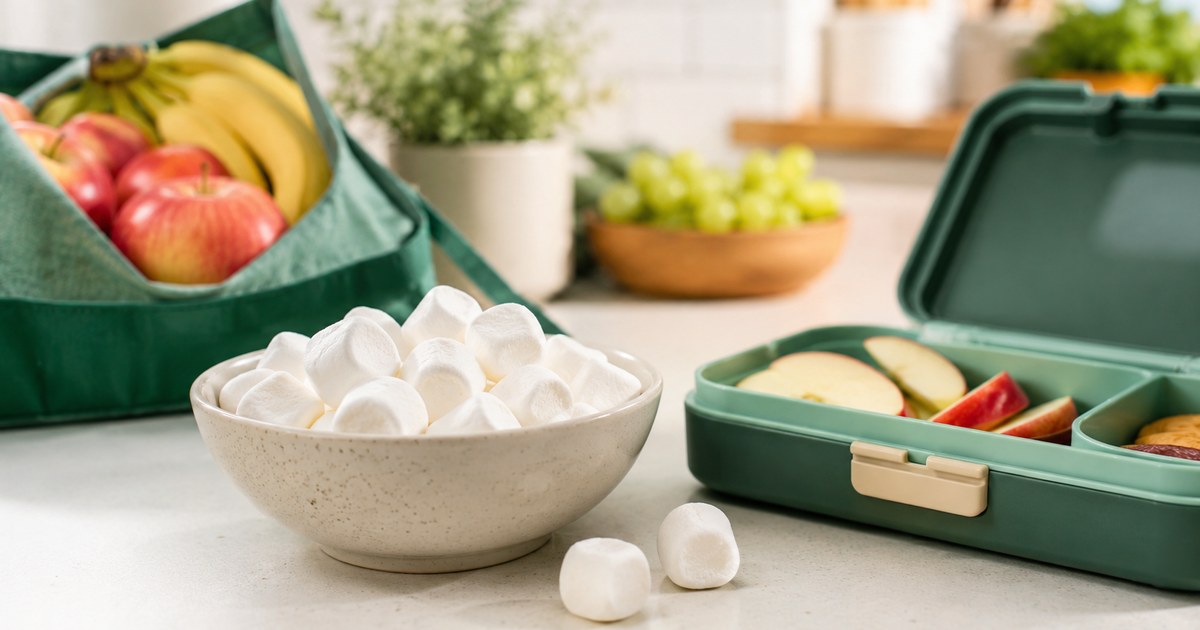
A packet of marshmallows is a small decision made at speed, usually at half past seven in the morning with a lunchbox open and a school bag by the door. So the useful version of the question “are marshmallows halal” is not a philosophical one. It is: what can I tell from this packet, in about eight seconds, before I put it in or leave it out.
The honest answer is that a marshmallow is mostly sugar, water and air, and the whole question rests on one ingredient: the whipping agent that holds the foam together. When that agent is gelatine, the packet has raised a question it usually does not answer, because gelatine can come from cattle, from pigs, or from fish, and the word alone does not say which.
What is actually in a marshmallow
Wikipedia’s entry describes the modern marshmallow as four things: sugar, water, air, and a whipping agent, usually a protein. On a supermarket packet that protein is commonly gelatine. In some, particularly marshmallow creme and fluff style products, it is egg white, also called albumen. Everything else on the packet, the corn syrup, the starch dusting, the colour, the vanilla flavour, is doing a supporting job.
That narrows the reading enormously. You are not auditing a list of twenty ingredients. You are looking for one word and then asking what it is made of.
Why “gelatine” on its own is a question, not a verdict
Gelatine is collagen, extracted with heat and acid or alkali from animal connective tissue. Wikipedia’s entry on gelatine states that most gelatine is derived from pork skins, pork and cattle bones, or split cattle hides, and notes separately that gelatine made from fish by-products avoids some of the religious objections to gelatine consumption. So the same word on two different packets can describe materials with completely different origins.
That is the definition of the mushbooh category: not forbidden, not established, simply undecided on the evidence in front of you. An unqualified “gelatine” in an ingredient list is a signal to look further, not a conclusion.
The same tension sits behind Jell-O and other gelatin desserts, which turn on the identical ingredient and the same source-by-source reading.
Named bodies handle that uncertainty differently, and it is worth knowing that they do. IFANCA’s Halal Shopper’s Quick Reference Guide lists gelatin in its “Haram / Avoid” column, alongside lard, animal shortening and hydrolysed porcine collagen, without a qualifier, which is a deliberately cautious consumer shortcut. The American Halal Foundation sets out a source-by-source position instead: bovine gelatine is acceptable where the animal was one permissible to eat and was slaughtered according to Islamic law, porcine gelatine is not, fish gelatine is generally considered acceptable by most scholars, and plant-based gelling agents such as agar-agar and carrageenan are unrestricted by default.
There is also a documented scholarly argument in the background about whether chemical transformation, istihalah, changes the status of the finished material. Islam Q&A’s answer on gelatine reports the Islamic Organization for Medical Science arguing that the chemical processing amounts to complete transformation, and reports the contrary analysis that the transformation is only partial. It records that the Islamic Fiqh Council in Jeddah nonetheless held gelatine from pig sources impermissible, particularly given that alternatives from Islamically slaughtered animals are available. The American Halal Foundation’s published standard takes the same line, stating that a chemical transformation is not sufficient for a haram-sourced gelatine to be deemed halal. These are the positions as their holders state them, reported here rather than ruled on.
What “beef gelatine” does and does not settle
Plenty of packets now say “beef gelatine” or “bovine gelatine” rather than just “gelatine”, and that is a genuine improvement. It settles the species. It rules out the pork question, which is the one most parents are actually worried about.
What it does not settle is how the animal was slaughtered. Every position quoted above that accepts bovine gelatine attaches a condition to it, and that condition is the slaughter, not the species. The American Halal Foundation’s wording is explicit on this: the animal must be permissible to eat and slaughtered according to Islamic law. A packet that says “beef gelatine” has answered the first half of the requirement and left the second half unstated. So has a packet that says “halal beef gelatine” without naming a certifier, since that is a manufacturer’s claim rather than an audited one.
This is a limit no label-reading tool can get past, and it is worth being clear about. Reading ingredients tells you what an ingredient is. It cannot tell you how an animal was slaughtered, who supervised it, or what else ran through the same production line. Only a certification body that has actually audited the supply chain can speak to that, which is why a certifier’s mark on the front of the packet is worth more than any amount of careful reading on the back.
The routes that avoid the question
There are two clean ways past all of this, and both are easy to spot in a supermarket.
The first is a halal certification mark on the packet. Marshmallows made with gelatine from certified halal-slaughtered cattle are widely produced, and the mark means a body has checked the sourcing rather than a manufacturer having asserted it. This is the shortest route and the one worth defaulting to when a product is going into a lunchbox every week.
The second is gelatine-free. Wikipedia’s marshmallow entry notes that versions exist which use a non-animal gelling agent such as agar, and that several brands of vegetarian and vegan marshmallows and marshmallow fluff are on the market. Agar comes from seaweed, pectin from fruit, and both appear in confectionery as setting agents. Aquafaba, the viscous water that chickpeas have been cooked in, works as a direct replacement for egg white in meringues and marshmallows, which is how most vegan versions get their foam. A marshmallow whipped with aquafaba or set with agar settles the gelling-agent question, which is the one this article is about. It does not by itself settle the flavourings, the other ingredients on the panel, or what else ran on the same line.
Egg-white marshmallows sit in between: the protein is not gelatine and raises no slaughter question, but many products combine albumen with gelatine rather than replacing it, so the word “gelatine” still needs to be absent from the list, not merely joined by something else.
The eight-second version at the shelf
Look for a halal certification mark from a certifier you follow, and check it is current and covers this product. If you have that, the sourcing work has been done by people who can see the supplier records. If there is no mark, find the whipping agent in the ingredient list. Agar, pectin, aquafaba or chickpea water means no animal-origin question. Egg white with no gelatine listed means the same. An unqualified “gelatine” means the packet has not told you enough, and “beef gelatine” without a certifier means it has told you the species and not the slaughter. That is the same reading order that works for any packaged food, applied to a bag of sweets, and the gelatine ingredient page goes deeper on the sources.
None of this is a reason for guilt about anything already eaten, and none of it needs to turn a lunchbox into a research project. Zabihah reads the printed ingredient list and gives AI-assisted general guidance from it, flagging gelatine as doubtful when the source is unstated and telling you why. It is not a fatwa, it does not replace certification, and it cannot verify slaughter or what else ran through the factory. For anything that matters to you, an official halal certification and your own scholar remain the final word.