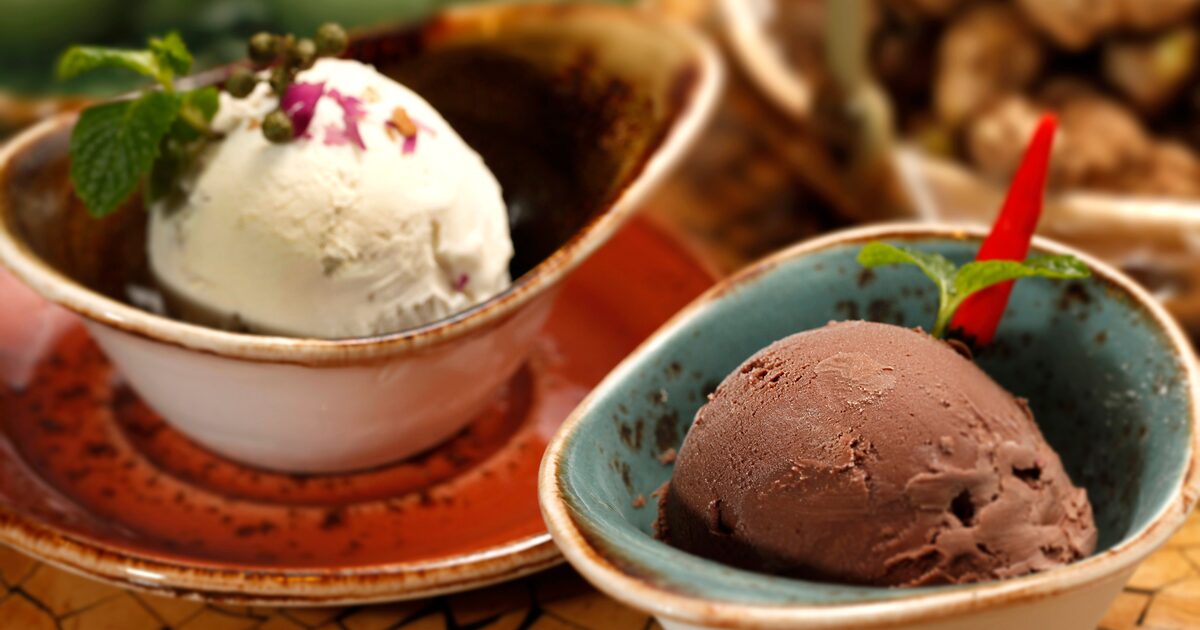
A tub of ice cream looks like it should be simple, and mostly it is. Wikipedia’s entry describes ice cream as a sweetened frozen food typically made from milk or cream, sweeteners and a flavouring, sometimes with other ingredients added. Milk, cream and sugar raise no question. So “is ice cream halal” is really a question about the short list of extras that turn a cold dairy mix into a shelf-stable, scoopable product.
The useful version of the answer is that most of a tub is uncontroversial, and the whole decision comes down to at most four additives: the emulsifier, any gelatine or stabiliser, the flavour carrier, and, in some coloured flavours, the dye. Each of those can be plant, synthetic or animal-derived, so the certifiers and scholars below read the source of each rather than issuing a verdict on ice cream as a category.
The four things worth finding on the panel
The first is the emulsifier. Mono- and diglycerides (E471) are the most common one in ice cream, and, as Wikipedia’s entry on them notes, they are made from glycerol and fats or oils that can be plant or animal in origin. IFANCA, the Islamic Food and Nutrition Council of America, places mono- and diglycerides in the “Investigate Further” column of its ingredient guide for exactly that reason: the fat feedstock can come from haram animals, from alcohol, or from halal animals slaughtered by non-Muslims. Our guide to mono- and diglycerides covers the emulsifier in full.
The second is gelatine or a similar stabiliser. Some ice creams, particularly softer or lower-fat styles, use gelatine to hold texture. Gelatine is the ingredient behind the marshmallow question, and the American Halal Foundation reads it source by source: bovine gelatine is acceptable where the animal was permissible and Islamically slaughtered, porcine is not, and fish gelatine is generally accepted. Many ice creams instead use plant stabilisers such as guar gum, locust bean gum or carrageenan, which do not raise the animal-origin question.
The third is the flavour carrier. Real vanilla ice cream is usually flavoured with vanilla extract, which, as Wikipedia’s entry on it records, is made by percolating vanilla in a solution that contains ethanol, and finished extracts retain a percentage of alcohol. Whether that trace matters is a question on which named certifiers genuinely differ, and we set out the positions in vanilla extract and alcohol on a label. It is one of the clearest cases where reputable bodies disagree rather than align.
The fourth applies mainly to coloured flavours. Strawberry and other pink or red ice creams sometimes use carmine, a red dye derived from insects, whose status is itself contested among scholars. IFANCA lists natural and artificial flavourings in its “Investigate Further” column too, because a flavour’s own subcomponents can trace back to animal or alcohol sources.
Why the same flavour can get two answers
Because every one of those four is source-dependent, two tubs of vanilla ice cream on the same shelf can reach different conclusions. One might use a vegetable emulsifier, a plant stabiliser and a certified flavour; the other might use an unspecified E471 and a vanilla extract carrying alcohol. The words on the panel look similar, but the sourcing behind them is not, which is why a category-wide “ice cream is halal” or “ice cream is haram” statement is not something the label supports. This is the ordinary mushbooh pattern: the rule is settled, and what is missing is a fact about this particular tub.
What a mark on the tub actually buys you
A halal certification mark from a body you follow is worth more here than reading the panel carefully, because it covers all four watchpoints at once. A certifier has checked the emulsifier’s fat source, the stabiliser, the flavour carrier and the colour, which is precisely the set of facts a label leaves unstated. Ingredient reading, by contrast, can tell you what an ingredient is, but not how an animal in the supply chain was slaughtered or what ran on a shared line.
The quick read at the freezer
Scan for a certification mark first. Without one, find the emulsifier (a “vegetable” qualifier on E471 helps), check whether the stabiliser is gelatine or a plant gum, note whether the flavour is a vanilla extract carrying alcohol, and look for carmine in coloured flavours. A plain dairy ice cream with a vegetable emulsifier and plant stabilisers has little left to question. An unqualified E471, an unspecified gelatine or an alcohol-carrying flavour is the doubtful case, and doubtful means the panel has not told you enough, not that the tub is forbidden. The same reading order works for any packaged food.
Zabihah reads the printed ingredient list and gives AI-assisted general guidance from it, flagging each of these watchpoints as doubtful when the source is unstated and telling you which one triggered the flag. It is not a fatwa and not a substitute for certification, and it cannot verify slaughter or what else ran through the factory. For anything that matters to you, an official certification and your own scholar or certifying body remain the deciding voice.