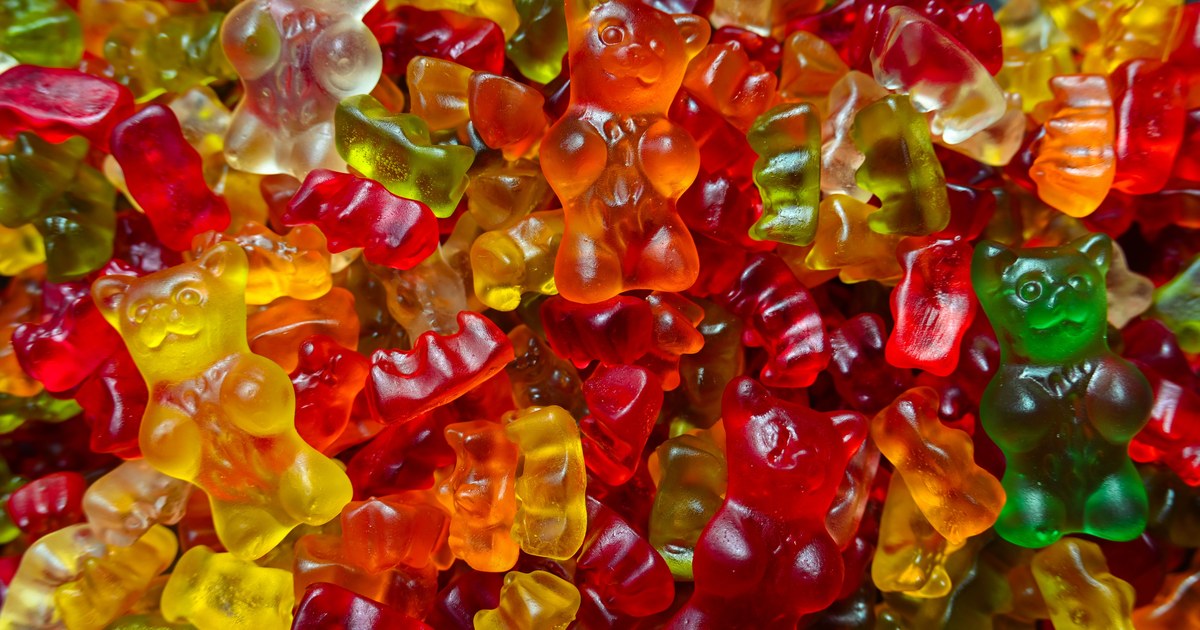
Gummy bears are the sweet most likely to arrive in a house without being bought there. They come home in party bags, from a classmate’s birthday, from a relative who meant nothing by it. So the question is usually asked after the fact, with a small plastic bag in one hand and no packet to read, which is exactly the situation worth preparing for in advance.
The short version of “are gummy bears halal” is that a standard gummy bear is a gelatine sweet, and gelatine is the whole question. Named bodies treat pig-derived gelatine as impermissible and treat cattle-derived gelatine as depending on how the animal was slaughtered, so an unlabelled gummy leaves both possibilities open. The manufacturer’s own catalogue is often the fastest place to find out which one you have.
What a gummy bear actually is
Strip a gummy bear back and it is sugar, glucose syrup, acid, flavouring, colour and one structural ingredient that turns the syrup into something you can bite. That structural ingredient is almost always gelatine, and it is doing the same job it does in a marshmallow or a set dessert. Everything else on the panel is supporting cast.
That single dependency is why the sweet is worth more attention than its size suggests. The post on marshmallows and the gelatine question sets out the general problem, and the post on a boxed gelatin dessert shows the same logic in a different format. A gummy bear is the confectionery version of the identical issue, with the added difficulty that it is very often eaten away from its packaging.
What the American Halal Foundation says
The American Halal Foundation publishes a list of foods that may contain pork, and gummy candies appear on it through their gelling agent. AHF describes gelatin as often derived from pork and used as a gelling agent, and in the same guide answers the direct question about sources by stating that gelatin can be made from pork, beef, fish or plant sources, but that most commercially available gelatin comes from pork. That is a statement about the general commercial supply of an ingredient, not a verdict on any particular brand, and it is worth reading as exactly that.
In its separate guidance on gelatin, AHF sets out the standard that applies when the source is not pork. It states that gelatin sourced from pigs is haram, and that for gelatin to be halal it must be sourced from animals slaughtered according to Islamic law, with the animal being one that is permissible to eat and slaughtered by a Muslim in the name of Allah. AHF adds that halal certification bodies verify the origin of the gelatin’s animal source rather than taking it on trust.
The consequence is the part shoppers most often miss. “Beef gelatine” on a label rules out the pork question, but it does not answer the slaughter question, and a label has no way of reporting slaughter method. IFANCA, the Islamic Food and Nutrition Council of America, places gelatin outright in the avoid column of its Halal Shopper’s Guide to Ingredients rather than in its investigate-further list, which is a stricter reading than treating it as an open question. Two named bodies, two slightly different levels of caution, and both point at certification as what closes it.
Haribo’s own catalogue answers part of the question
Here is the detail that changes how this decision is made in practice, and it comes from the manufacturer rather than from a third party. Haribo’s German online shop runs a dedicated Halal category, and the range it lists may not match what turns up on a shelf outside that market. Its own framing is direct: it tells shoppers who want to avoid pork gelatine that they will find halal gummy sweets at Haribo, and it lists around ten products plus a bundle in that range, including Goldbären, Tropifrutti, Happy Cola, Croco, Happy Cherries and others. The category page presents the range under a heading describing them as certified halal products, though the page itself does not name a certifier or link a viewable certificate.
The individual product pages carry the same information at ingredient level. The listing for Goldbären Halal 100g names its gelling agent explicitly as “Gelatine (Rind)”, which is beef gelatine, rather than leaving the source unstated the way an ordinary confectionery panel does.
That is the useful discovery, and it is not a recommendation. One manufacturer runs two product lines side by side: an ordinary range and a separately labelled halal range with a differently sourced gelatine. It reframes the practical task. The job is not to decide whether a brand is acceptable in the abstract. The job is to find the specific labelled product, because the brand name on the front of the bag does not determine the answer and the range does.
It is worth being equally clear about what Haribo’s pages do not tell you. The product page names the gelatine source but does not name the certifying body, so the pack’s own certification mark, and the standard behind it, is still the thing to look at. A manufacturer describing its own product is a starting point rather than an audit, which is precisely why an independent certifier exists.
Two different fixes for the same worry
Put this next to Skittles and the contrast is instructive, because the two products solved the same shopper’s worry in opposite ways.
With Skittles, the manufacturer removed gelatine from the recipe altogether and replaced its function with starch-based ingredients. The animal question disappears because the animal ingredient disappears, and what remains to check is the colours, the flavourings and the certification.
With gummy bears, the gelatine stays, because it is what makes the sweet a gummy at all. So the fix has to be sourcing rather than removal: a different gelatine, from a different animal, handled to a different standard, sold as a separate product line. One product answered the question by subtraction and the other by substitution. Knowing which kind of fix a product used tells you what to look for on the pack, and it explains why an unlabelled gummy sits squarely in the mushbooh category while an unlabelled Skittle mostly does not.
The quick read at the shelf
Find the gelling agent on the panel. If it says gelatine with no source, the source is genuinely unknown from the label alone, and AHF’s description of the commercial supply is the reason that matters. If it says beef or bovine gelatine, the pork question is answered and the slaughter question is not, since no label reports slaughter method. If it names pectin, agar, starch or carrageenan, the sweet is not a gelatine product at all and the question does not arise. If a halal certification mark from a body you follow is on the pack, it covers the source, the slaughter and the facility together, which is the only thing that does all three at once.
For sweets that arrive without packaging, the honest answer is that there is nothing to read, and a photograph of a loose gummy bear cannot be made to tell you what a missing label would have said.
Zabihah reads the printed ingredient list and gives AI-assisted general guidance from it, so it can tell you when a panel names gelatine without a source and explain why that leaves the question open. It cannot verify slaughter method, inspect a factory, or see a supplier’s paperwork, and it is not a fatwa or a substitute for certification. For a specific pack, an official halal certification and your own scholar or certifying body remain the deciding voices.