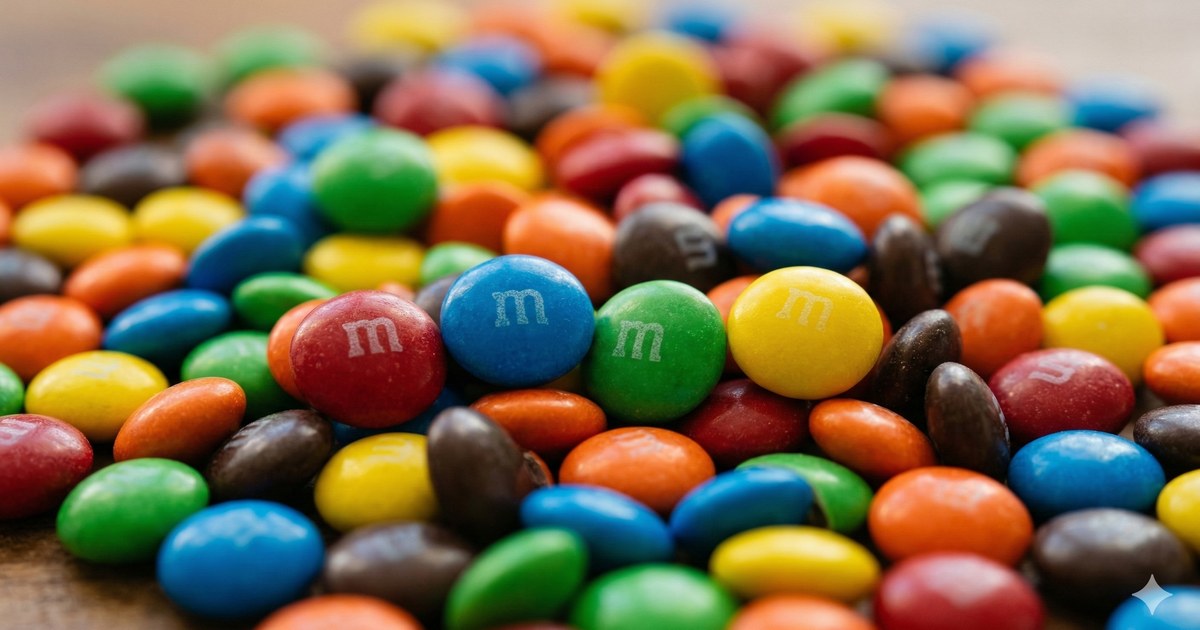
Ask around online and the same claim comes back with total confidence: the candy shell on M&M’s contains gelatin, or shellac, or both. It travels through parent group chats and comment threads, and it is the single biggest reason people type “are M&M’s halal” into a search bar. It is also, on the pack most American shoppers are holding, not what the printed ingredient list says.
“Are M&M’s halal” is usually asked because of a rumour about gelatin or shellac in the candy shell. The printed US ingredient panel for Milk Chocolate M&M’S names neither. The shell is sugar, cornstarch, corn syrup, dextrin, synthetic colours, carnauba wax and gum acacia. The open questions are the flavouring line and certification.
What the US panel actually lists
The ingredient statement recorded from a US Milk Chocolate M&M’S pack reads: milk chocolate (sugar, chocolate, skim milk, cocoa butter, lactose, milkfat, soy lecithin, salt, natural flavor), sugar, cornstarch, and then, at less than one per cent, corn syrup, dextrin, colors including Blue 1 Lake, Yellow 6, Red 40, Yellow 5, Blue 1, Yellow 6 Lake, Red 40 Lake, Yellow 5 Lake, Blue 2 Lake and Blue 2, carnauba wax and gum acacia.
Read that line by line and the rumour has nowhere to stand. There is no gelatin. There is no shellac, no confectioner’s glaze and no resinous glaze. The two ingredients doing the work people attribute to those words are carnauba wax, a wax from the leaves of a Brazilian palm, and gum acacia, the dried sap of acacia trees. Both are plant materials, and a shopper checking for an animal-source ingredient in the shell will not find one on this panel.
That is worth saying plainly because the rumour is not baseless in general. Shellac genuinely is used as a glaze on other panned sweets. Wikipedia describes shellac as a resin secreted by the female lac bug on trees in India and Thailand, and IFANCA, the Islamic Food and Nutrition Council of America, names jelly beans and malted milk balls as typical glazed confectionery in its article on insect-derived ingredients. A shopper who learned to check for confectioner’s glaze on one glossy sweet reasonably assumed it applied to the next one. On M&M’S, the printed panel says otherwise.
Where the shine actually comes from
Panned confectionery gets its finish in two stages, and the second stage is where the glaze goes. On this pack the polish step is carnauba wax, with gum acacia acting as the binder that lets the coloured sugar layers build up smoothly. Neither one raises the question the rumour assumes.
This is the same shape of correction our post on Starburst reaches from the other direction. There, the US panel names gelatin outright, in plain English, and the question that follows is entirely real. Here the panel names nothing of the kind. The lesson is the same either way: the printed list settles the source question far more often than a brand’s reputation does, and the two sweets sitting side by side in the same aisle can give opposite answers.
The colours, which are the part people are right to notice
The dye list on the US pack is long, and it is genuinely the most talked-about part of this product. Red 40, Yellow 5, Yellow 6, Blue 1 and Blue 2, along with their aluminium lake versions, are synthetic certified colours rather than anything extracted from an animal or an insect. Our post on Red 40 sets out why this family of dyes is usually the easier half of a confectionery label rather than the hard part.
Wikipedia’s article on M&M’s records a piece of history that explains why red dye in particular attracts suspicion. Red M&M’s were withdrawn in 1976 over public concern about the safety of Red Dyes No. 2 and No. 4, and Wikipedia records that the M&M’s actually on shelves at the time were made with the less controversial FD&C Red No. 40, not the dye the scare was about. The colour returned in 1987 after a student campaign. A withdrawal driven by consumer worry rather than by the recipe is exactly the kind of episode that hardens into folklore, and some of the modern rumour traffic around this brand is a descendant of it.
The line that stays genuinely open is the flavouring. The US panels checked for this product list “Natural Flavor”, which is the same territory our post on Skittles treats as the remaining question once the gelatine question is closed. IFANCA places natural and artificial flavourings alike in the Investigate Further section of its Halal Shopper’s Guide to Ingredients, describing them as small-quantity components that can carry subcomponents derived from haram animals, from alcohol, or from halal animals slaughtered by non-Muslims, and it directs shoppers to ask the manufacturer. The word “natural” on the panel is not, on its own, a reason to skip that question.
The UK pack is where an insect-derived ingredient really appears
Here is the part the rumour gets backwards. The insect question is not absent from this brand, it is just on a different continent and attached to a different ingredient.
The ingredient statement recorded from a UK M&M Peanut pack lists colours as E100, E120, E133, E160a, E160e and E170, with the glazing agent given as carnauba wax. E120 is carmine. Wikipedia’s entry on M&M’s states the same thing in words, noting that in Europe the red M&M’s contain the red dye carmine. Wikipedia’s article on carmine describes it as a dye obtained from carminic acid produced by cochineal insects, historically the scale insect Dactylopius coccus.
So the UK and European packs swap a set of synthetic dyes for a palette that includes a genuinely insect-derived colour, while the US pack does the reverse. That is not a small detail for a reader weighing this question, because insect-derived ingredients are where named authorities actually differ. IFANCA, quoting Sheikh Rachid Belbachir, records that the schools of Islamic jurisprudence other than the Maliki prohibit the consumption of insects, while the Maliki school permits them so long as no harm results, with the locust permitted by all schools. The American Halal Foundation, in its guide to halal and haram ingredients, describes carmine as a red dye derived from insects that is often considered haram. Those are two reasoned positions on the same known ingredient, and choosing between them belongs to your own school and scholar rather than to a website.
The practical consequence is simple. A shopper who settles this question in one country has not settled it in another, and the pack that looks identical on the shelf may be a different document on the back.
Plain and peanut are close, but not identical
The US peanut variant runs on the same shell system. Its panel adds peanuts and palm oil, while keeping the same colour list, the same carnauba wax and the same gum acacia. No gelatin and no shellac appear there either. The difference between the two US varieties is a nut and a vegetable fat, not a change in the animal-source picture.
The UK peanut pack is the one carrying carmine in its colour list, which means the plain-versus-peanut comparison matters far less than the market comparison. Turn the pack over and find where it was made before you compare varieties.
The quick read at the shelf
Start with the country, then the panel, then the glaze line, then the colours. If the glazing agent is carnauba wax or gum acacia, the shellac question does not arise on that pack. If the colour list is made of numbered synthetic dyes, no insect-derived colour is involved, and Red 40 and its neighbours sit in the easier category. If the colour list includes E120 or carmine, you are in the insect question where IFANCA reports the Maliki school and the majority differ, and where the American Halal Foundation’s own guide describes carmine as often considered haram. If the flavouring line reads “natural flavor” or “artificial and natural flavors”, that is the line IFANCA asks you to take to the manufacturer. And a halal certification mark from a body you follow is the only thing on a pack that covers the sourcing, the flavours and the facility together, which is also why the same cookie can reach two different answers in two different countries, as our post on Oreos works through.
Zabihah reads the printed ingredient list and gives AI-assisted general guidance from it, so it can tell you that a panel names carnauba wax rather than shellac, or that a colour list includes E120, and it can flag the categories a named authority would ask you to investigate. It is not a fatwa and it is not a substitute for certification, and it reads labels rather than inspecting a factory or a supplier’s blend sheet. For the pack in your hand, an official halal certification and your own scholar or certifying body remain the deciding voices.
Sources
- M&M'S Milk Chocolate Candies, US ingredient panel (Open Food Facts)
- Peanut M&M'S, US ingredient panel (Open Food Facts)
- M&M Peanut, United Kingdom ingredient panel (Open Food Facts)
- M&M's (Wikipedia)
- Carmine (Wikipedia)
- Shellac (Wikipedia)
- IFANCA: Are There Bugs in Our Food, Medicine, and Make-Up?
- IFANCA: Halal Shopper's Guide to Ingredients
- American Halal Foundation: A Comprehensive Guide to Halal and Haram Ingredients